
College Station Epoxy Flooring installs polyaspartic and polyurea floor coatings across College Station, Texas and the surrounding cities of Bryan, Lake Bryan, Navasota, Caldwell and Hearne, with more than 20 years behind the work. Polyaspartic is the material people ask for by name when they want a floor back quickly, and it genuinely delivers that. It is also the material least tolerant of being applied carelessly.
Its two real advantages are speed and color stability. It cures fast enough to return a floor to service in a fraction of the time an epoxy build needs, and it holds its color under ultraviolet light rather than ambering the way epoxy does at a sunlit door line. Those are not marketing claims, they are the reason the product exists.
The trade-off is a working window measured in minutes rather than hours, which on a hot slab in this market gets shorter still. That is why we treat scheduling as part of the specification rather than as logistics.
What Polyaspartic Actually Is
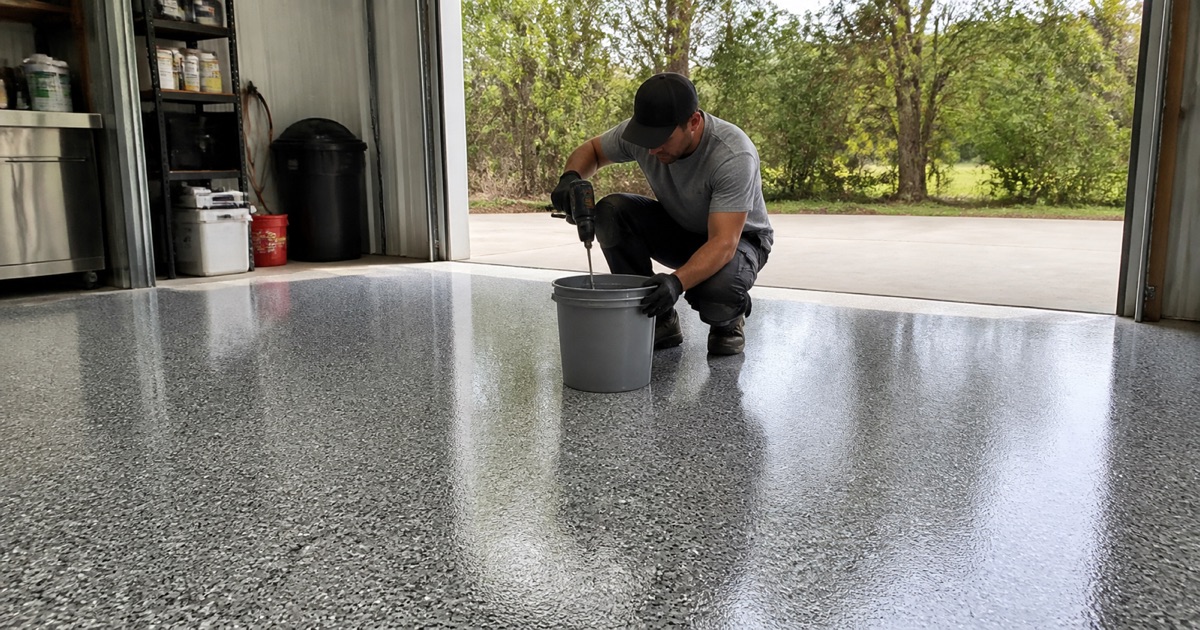
Polyaspartic and Polyurea
Polyaspartic is a subset of polyurea chemistry, engineered specifically to slow the reaction enough that a floor can be applied by hand rather than sprayed by machine. Standard polyurea cures in seconds and is a plural-component spray product; polyaspartic buys the installer working time while keeping most of the toughness. Both are aliphatic, which is the property that gives the color stability, and both are considerably more abrasion resistant than a standard epoxy topcoat. The practical consequence is that the two names get used interchangeably in sales conversations when they describe genuinely different application methods.
Where It Beats Epoxy
Ultraviolet stability is the clearest advantage, and it matters anywhere daylight reaches the floor, which in a garage means the whole area inside the door. Fast return to service is the second, and it decides jobs on a lease calendar or in a business that cannot close. Low-temperature cure is the third and least discussed, since polyaspartic will cure at temperatures where an epoxy has effectively stopped. That matters here during the short cold spells rather than across the winter as a whole, since freezing nights are uncommon in this market.
Where Epoxy Still Wins
Epoxy builds film thickness economically in a single pass and bonds superbly to properly prepared concrete, which is why it remains the body of most systems rather than the top. It also tolerates a slower, more forgiving application. A floor built entirely from polyaspartic is possible and is occasionally right, but it is usually a more expensive way to reach the same place. We will build one when the schedule justifies it and say so plainly when it does not.
Systems We Build With It
Epoxy Body With a Polyaspartic Topcoat
This is the standard residential garage build in this market and the one we recommend most often. A 100 percent solids epoxy carries the thickness and the bond, and the polyaspartic topcoat carries the light, the abrasion and the chemical exposure. It gives the durability of the epoxy without inheriting its weakness at the door line. It is also the build most forgiving of a crew working through changing conditions across a day.
Full Polyaspartic Builds
Where a floor absolutely must return to service inside a day, a full polyaspartic system with a broadcast layer between coats is the answer. It costs more per square foot and demands tighter crew coordination, because every coat has its own short window. On the right job, particularly a rental turnover against a fixed handover date, that cost is straightforwardly worth paying. The scheduling discipline it demands is the real cost, not the material.
Flake and Quartz Broadcasts
A vinyl flake or quartz aggregate broadcast is dropped into the base coat and locked under the polyaspartic top. Beyond appearance it adds slip resistance and disguises slab imperfection, and the topcoat thickness over the broadcast is what determines whether the finished floor feels smooth or textured underfoot. That is a choice worth making deliberately rather than inheriting from a sample board. Slip resistance and cleanability pull in opposite directions here, and the right point between them depends on the room.
Why Timing Decides the Job
Pot Life on a Warm Slab
Working time falls sharply as temperature rises. Published manufacturer figures across this class of product show pot life dropping from around 2 hours at 50 degrees to roughly 1 hour at 75 degrees and to about 30 minutes at 100 degrees, and batch size compounds the effect. That is why a hot afternoon changes how much material we mix at once rather than how fast anyone works. We mix to the conditions in front of us rather than to a fixed recipe, which is why the same floor is sequenced differently in July than in March.
The Dew Point Window
The working rule across manufacturer data sheets is that the slab surface must sit at least 5 degrees above the dew point, and it is measured at the slab rather than in the air because concrete lags air temperature. On summer mornings here that margin is frequently absent at dawn and clears late in the morning, which is precisely why our start times look late to anyone watching from outside. Starting early and finishing early is the version of this job that fails, and it fails weeks later rather than that day.
Recoat Windows and Their Deadlines
Every coat has a minimum recoat time and a maximum one, and the maximum is the one that catches people out. Exceed it and the manufacturer requires the surface be mechanically abraded before the next coat can go on, which turns a simple second pass into another full operation. On a fast product those windows are short, so sequence and crew size are planned around them. Missing a maximum recoat window on a fast product is the most expensive avoidable mistake in this system.
Humidity and Amine Blush
High humidity during cure can leave a greasy amine blush on an epoxy body coat that will destroy the bond of anything laid over it. It is preventable through product selection and timing and removable if it is caught, but only if somebody recognizes it before the topcoat goes down. On a fast-cure system there is very little time to notice. Recognizing it is a matter of knowing what to look for at the right moment rather than of testing for it afterward.
Where We Use It Beyond the Garage
Commercial Floors That Cannot Close
A retail floor, a clinic corridor or a restaurant kitchen frequently cannot give up more than a night. Polyaspartic is the only realistic way to hand a usable floor back on that timescale, and the whole job gets planned around the window rather than the other way round. We agree the handover hour before quoting, because it determines the system as much as the traffic does.
Rental Turnovers on a Fixed Date
Turnover work in this market runs against a lease calendar rather than a contractor’s schedule, so the handover date is effectively part of the specification. A fast-cure build exists precisely for that constraint, and it is the honest answer when the window is genuinely tight rather than a way to charge more for the same floor.
Service Bays and Workshop Floors
Hot tire pickup, dropped tools and solvent exposure are the working conditions in a shop bay, and a polyaspartic topcoat handles all three better than an epoxy surface does. Cure schedule still governs, since a floor loaded before it has cured through will fail regardless of what is on top of it.
Exterior and Semi-Exterior Slabs
Covered patios, loading aprons and walkways take direct daylight, which is where the color stability earns its keep. Exterior work brings its own constraints around thermal cycling and drainage, so the slab is assessed for those separately rather than treated as an indoor floor that happens to be outside.
- 20+ Years in the Brazos Valley
- Insured & Registered
- Free Written Proposals