
College Station Epoxy Flooring repairs failed and damaged resinous floors throughout College Station, Texas and the surrounding cities of Bryan, Lake Bryan, Navasota, Caldwell and Hearne, with more than 20 years of experience in what makes these systems let go. Repair work is diagnostic before it is anything else.
A floor that has peeled, blistered or delaminated is telling you something specific, and the single most expensive mistake in this trade is recoating over the cause. The new floor then fails the same way on roughly the same schedule, and the second repair starts by removing the first one.
So we take readings and samples before quoting. Sometimes the answer is a straightforward repair. Sometimes it is that the floor has to come off entirely, and we would rather say that at the estimate than halfway through.
Reading the Failure
Blisters, Bubbles and Osmotic Pressure
Blistering usually means vapor pressure from below exceeded what the coating could hold. On this ground that is a routine finding rather than an unusual one, because water perches on the clay horizon under much of the area through winter and spring. We take moisture readings under a failed floor before quoting anything, since the number decides whether a repair is even sensible. A blistered floor over a high reading is a removal job rather than a patching job, and knowing that early saves the cost of finding out twice.
Peeling and Delamination
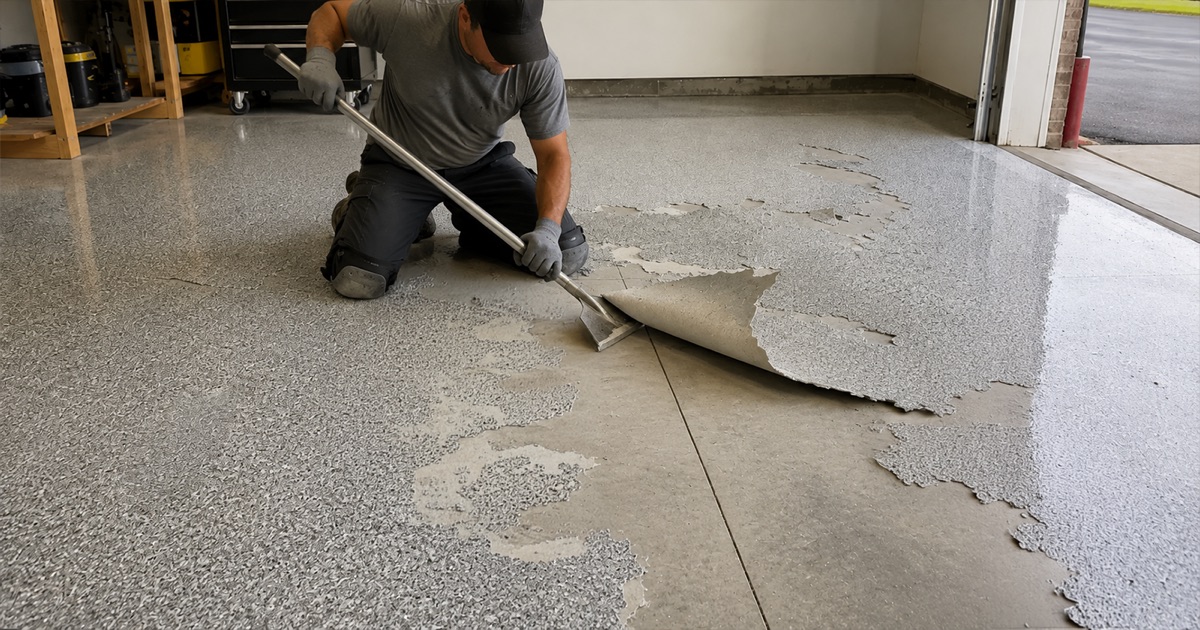
A coating lifting in sheets was bonded to something that let go, which is almost always a sealer, a curing compound, or a surface that was cleaned rather than mechanically opened. Sounding the floor maps the extent, and it routinely finds two or three times the area that looks bad from standing height. Tapping the floor takes minutes and changes the scope of most repair quotes we produce.
Hot Tire Pickup
Where a coating lifts in patches under vehicle tires, the system was either underspecified for vehicle traffic or was driven on before it cured through. This one is a specification and scheduling failure rather than a preparation failure, and the repair has to address the specification or it will simply recur. Returning a bay to service on the correct schedule is usually the cheaper half of that fix.
Wear, Scratching and Chemical Attack
Not every tired floor has failed. A coating worn through in traffic lanes, dulled by the wrong cleaner, or etched by a chemical it was never rated for may be structurally sound and a candidate for a recoat rather than a rebuild. Telling that apart from a bond failure is the whole point of the assessment. A sound floor that simply looks tired is the best outcome available on a repair call.
What Repair Actually Involves
Spot Repair Versus Full Removal
Where failure is localized and the surrounding floor is well bonded, we cut back to sound material, prepare the exposed slab and rebuild the system into the void. Where the bond has failed broadly, spot repair is a waste of money and the honest answer is full removal. Sounding the floor is what settles which of the two you have. We map the failed area rather than estimating it, because an estimate here is always optimistic.
Mechanical Removal
Failed coatings come off with PCD tooling ahead of a grinding pass, and the slab is then prepared to profile exactly as a new floor would be. Removal is slower and dustier than preparing bare concrete, so it is quoted as its own line rather than folded into a rate. Containment matters more on removal than on new work, since old coating dust carries further and is harder to clean up.
Moisture Mitigation Where It Is Needed
If the readings show vapor drive was the cause, the repair includes a moisture-mitigation primer or the job does not go ahead. Coating over a slab that is pushing water without addressing it is the definition of buying the same failure twice, and we will not quote it that way.
Blending a Repair Into the Existing Floor
A flake floor takes an almost invisible repair because the pattern hides the transition. A solid color blends reasonably. A metallic floor cannot be repaired invisibly at all, and we say so before starting rather than after. What system you have determines what a repair will look like when it is finished.
Cracks, Joints and Slab Movement
Live Cracks Under a Coating
A crack that keeps moving will telegraph through any coating laid over it, and filling it rigid guarantees that. Live cracks are treated as joints with a semi-rigid polyurea filler that supports the edges while permitting movement, and we say up front that it may show again, because a filler follows the slab exactly as the coating does.
Failed Joint Filler
On commercial floors, joint filler that has debonded or been chewed out by wheel traffic is a common repair in its own right. Refilling with a properly specified semi-rigid material restores edge support and stops the spalling that otherwise turns a joint into a widening maintenance problem.
When the Slab Is the Problem
Occasionally the floor is not the failure at all and the slab beneath it has moved, cracked structurally or lost its integrity. A coating repair does not address any of that. We will say when the honest recommendation is a concrete repair or a slab conversation rather than another floor.
- 20+ Years in the Brazos Valley
- Insured & Registered
- Free Written Proposals