
College Station Epoxy Flooring has been grinding and preparing concrete across College Station, Texas for more than 20 years, working throughout Bryan, Lake Bryan, Navasota, Caldwell and Hearne. Surface preparation is the least visible thing we do and the only one that decides whether a floor is still bonded in five years.
Almost every coating failure we are called out to look at traces back to this stage. The floor was clean but not opened, or it was etched instead of ground, or an old sealer was left in place and the new system bonded to that rather than to the concrete.
We sell preparation as its own service because it frequently is one, whether that is removing a failed coating, opening a slab for another trade, or grinding a floor flat before a covering goes down.
Opening the Concrete Properly
Grinding to a Measured Profile
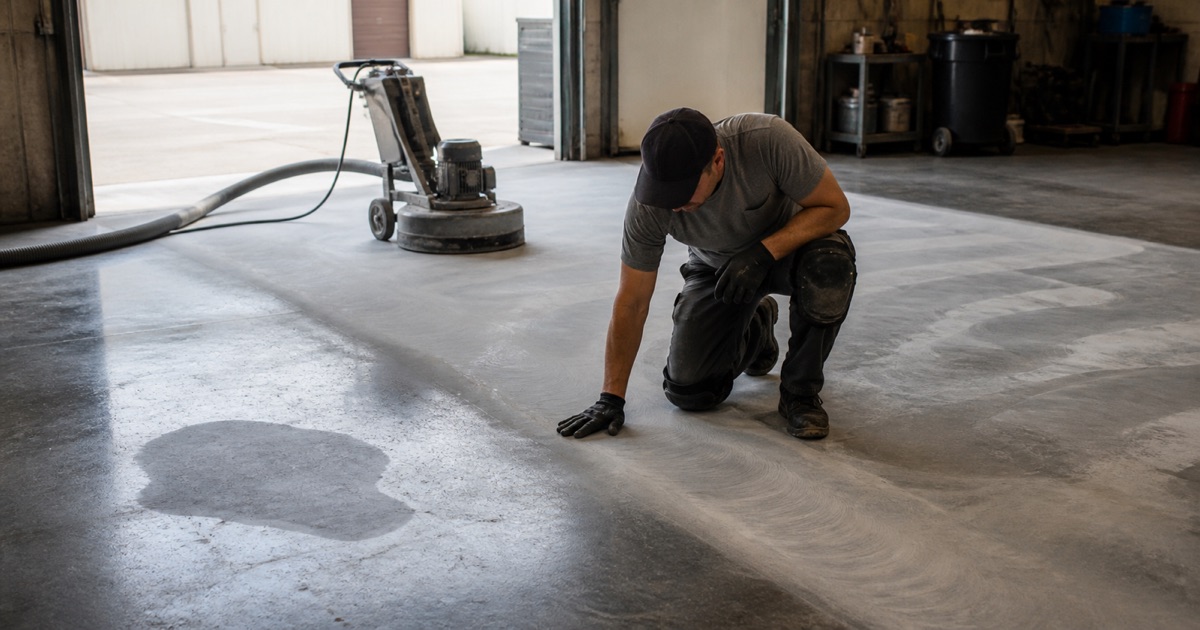
Diamond grinding removes the surface skin and opens the pore structure so a primer can key into it, and the result is measured against the ICRI concrete surface profile scale rather than judged by eye. Different systems want different profiles, and a thin coating over an aggressively opened slab telegraphs the texture while a thick build over a barely opened one has nothing to grip. We record the profile achieved so the coating manufacturer’s requirement can be checked against what the slab actually got.
Shot Blasting Larger Floors
Shot blasting propels steel media at the slab and recovers it in the same pass, which makes it faster and considerably cleaner than grinding across large open areas. It produces a more uniform profile on a big warehouse floor and it handles contamination well. It is less suited to edges, corners and confined residential spaces, so most jobs use both. On a mixed job the transition between the two methods is planned so the profile stays consistent across the boundary.
Matching Diamond Bond to the Slab
The rule runs opposite to intuition: hard concrete takes a soft bond and soft concrete takes a hard one. Get it wrong and a hard slab polishes the tooling while a soft slab is torn open by segments that never wear down. We test rather than assume, because the wrong first set costs a day and a set of diamonds. Hardness also varies across a single pour more often than people expect, so a large floor gets tested in several places.
What Has to Come Off First
Sealers and Curing Compounds
A slab that was sealed or cured with a membrane compound will not accept a coating until that layer is gone. These are frequently invisible, and a water-bead test takes seconds. Coating over a sealer is one of the two most common causes of the sheet peeling we get called to look at. The other is vapor pressure from below, and the two together account for the large majority of failures in this market.
Failed Coatings and Adhesives
Old epoxy, one-part garage paint, store-bought kits and tile adhesive all come off mechanically, usually with PCD tooling ahead of a grinding pass. Removal is slower and dustier than a straight grind, which is why we price it as its own line rather than discovering it mid-job and renegotiating. Knowing what is on the floor before quoting is worth the twenty minutes it takes to find out.
Oil, Grease and Contamination
Contamination that has soaked into the slab has to be drawn out or cut away rather than washed off, since a degreased surface can still be saturated below. Service bays and workshop floors are the usual candidates. Where contamination runs deep, we say what can and cannot be achieved before committing to a coating over it. An honest limit stated at the estimate is worth more than a guarantee nobody can keep on a saturated slab.
Repair That Happens at the Same Time
Cracks and Control Joints
Cracks are assessed for whether they are still moving. A settled crack is filled rigid and disappears under the coating; a live one is treated as a joint with a semi-rigid polyurea filler that supports the edges while allowing movement. Filling a working crack solid guarantees a line through the finished floor. We assess each crack individually rather than treating the whole floor to one method.
Spalls, Pits and Pop-Outs
Surface damage is rebuilt with an epoxy mortar or a patching compound chosen for compatibility with what goes over it. This happens after grinding and before priming, because a repair laid over primer is bonded to primer rather than to the slab. Compatibility between the repair material and the coating above it is checked rather than assumed.
Flattening and Levelling
Where a slab has lost its plane, grinding can take high spots down and a self-leveling underlayment can bring low areas up. Which approach applies depends on how much material is involved and what the finished floor has to do, and a floor that only needs to look flat is a different specification from one that has to be flat. Those two specifications differ by a large amount of money, so we establish which one is actually needed.
Dust, Access and Sequencing
Containment and Extraction
All of our grinding runs on vacuum extraction with dust collection, because concrete dust travels far further through a building than anyone expects and it is a genuine health matter rather than a housekeeping one. Containment gets agreed before the machines start rather than after somebody complains. Extraction also keeps the profile visible as we work, which matters for verifying it.
Working in an Occupied Building
Commercial preparation is usually sequenced in bays so a business can keep operating, with hard edges planned where each day stops. Noise, access routes and working hours get settled at the quote, since preparation is the loudest stage of any floor job by a wide margin. Most commercial clients would rather we work nights than lose floor area during trading hours, and we plan for either.
- 20+ Years in the Brazos Valley
- Insured & Registered
- Free Written Proposals