
College Station Epoxy Flooring has been installing epoxy garage floors in College Station, Texas for more than 20 years, serving surrounding cities including Bryan, Lake Bryan, Navasota, Caldwell and Hearne. A garage floor is the job most people in this market ask for first, and it is also the one most often sold on color when it should be sold on preparation.
The finish everyone looks at is the last few hours of the work. Everything that decides whether it is still bonded in five years happens before that: what the slab is sitting on, how much water vapor is moving up through it, and whether the concrete was opened up properly or merely cleaned.
That is the part we quote against. We grind, we test, and we write what we found into the proposal, so the specification you are buying can be checked against the floor you end up with.
Reading the Slab Before Anything Goes Down
Depth to the Clay Horizon
Most of this city is a thin sandy cap over a stiff clay horizon, and the cap can run anywhere from 2 to 18 inches. That depth changes what the slab is bearing on and what it is likely to do, so we establish it rather than assuming a regional answer that belongs to a different part of Texas.
Moisture Vapor Emission and Internal Humidity
We test with calcium chloride under ASTM F1869 and with in-situ relative humidity probes under ASTM F2170. The probes read humidity inside the slab at depth rather than at the surface, which is the measurement that actually predicts what a coating will face across its life, and both are held against the product’s ASTM F710 thresholds. A plastic sheet taped down overnight under ASTM D4263 is a presence-or-absence check and tells you nothing quantitative, which is why it is not what we quote against.
Existing Cracks and Joints
A crack that has stopped moving can be filled rigid and coated over. One that is still working cannot, and treating the second as the first guarantees a line telegraphing through the new floor within a season. We assess each on the slab and treat live cracks as joints with a semi-rigid polyurea filler. We also say before the job that a live crack may telegraph again, because a filler follows the slab exactly like the coating over it does.
Preparing the Concrete
Diamond Grinding and Shot Blasting
Every slab is opened mechanically to a measured ICRI CSP profile. Grinding suits a garage with a smooth power-floated surface; shot blasting moves faster on a large or heavily contaminated floor. Which one we use is a function of the slab, not of what is on the truck that morning. The profile is checked against the ICRI comparators rather than judged by eye, since the primer’s ability to key into the concrete is the entire basis of the bond.
Why We Never Acid Etch
Acid etching does not produce a consistent surface profile, it leaves residue that has to be neutralized and removed, and it cannot deal with a sealer at all. A coating bonded to an old sealer is only as strong as that sealer’s grip on the concrete underneath it, which nobody has measured. It is also the failure that looks fine at handover and lets go in sheets a year later, taking the sealer with it.
Removing a Previous Coating
Old garage coatings, particularly one-part paints and store-bought kits, come off with PCD tooling ahead of the grinding pass. Diamond segment bond hardness is matched to the concrete, since hard concrete takes a soft bond and the reverse, and getting that pairing wrong either polishes the slab or tears it. Removal is slower and dustier than a straight grind, and we price it as its own line rather than discovering it mid-job.
Choosing the System
Epoxy Body Coats
A 100 percent solids epoxy builds real thickness in a single pass and bonds hard to properly prepared concrete. It is the structural middle of most garage builds here, and its weakness is ultraviolet light, which ambers it wherever a door stands open through the afternoon. That is why a straight epoxy floor is a false economy in a garage that faces west, and why the topcoat carries the exposure instead.
Polyaspartic and Polyurea Topcoats
These cure fast, hold their color under sunlight and take the abrasion that a garage actually delivers. Used as a topcoat over an epoxy body, they are what makes a garage floor survive a Texas summer without yellowing at the door line. They also cure through a much wider temperature range, which matters here more than it would in a milder market.
Flake, Quartz and Solid Color
A vinyl flake broadcast hides slab imperfection and adds slip resistance underfoot, quartz aggregate does the same with a coarser and more industrial texture, and a solid color shows every undulation in the concrete. This is a genuine choice rather than an upsell, and slab condition should drive it. On an older slab with patching history, flake is the honest recommendation; on a newer slab in good condition, a solid color is a legitimate option rather than a compromise.
Our Step-by-Step Epoxy Garage Floor Process
Assessment and Moisture Testing
We look at the slab, identify what it is sitting on, run the moisture tests and record the results. If the numbers require a moisture-mitigation primer, that appears in the proposal rather than as a change order once the grinder is already running. Recording the readings also means a later dispute about the floor has numbers behind it rather than two recollections.
Clearing and Masking
The slab has to be completely empty, which is the step most often underestimated. We agree in advance who moves what and where it goes, then mask thresholds, walls and the step-down into the house. Masking is not cosmetic here, since airborne dust from a grinder travels much further than people expect through an open interior door.
Grinding, Repair and Priming
The floor is ground to profile, cracks and joints are treated according to what they are, spalls and pits are filled, and the primer goes down onto clean, opened concrete. Spalls and pits are filled at this stage rather than after priming, because a repair laid over primer is a repair bonded to primer.
Build Coat, Broadcast and Topcoat
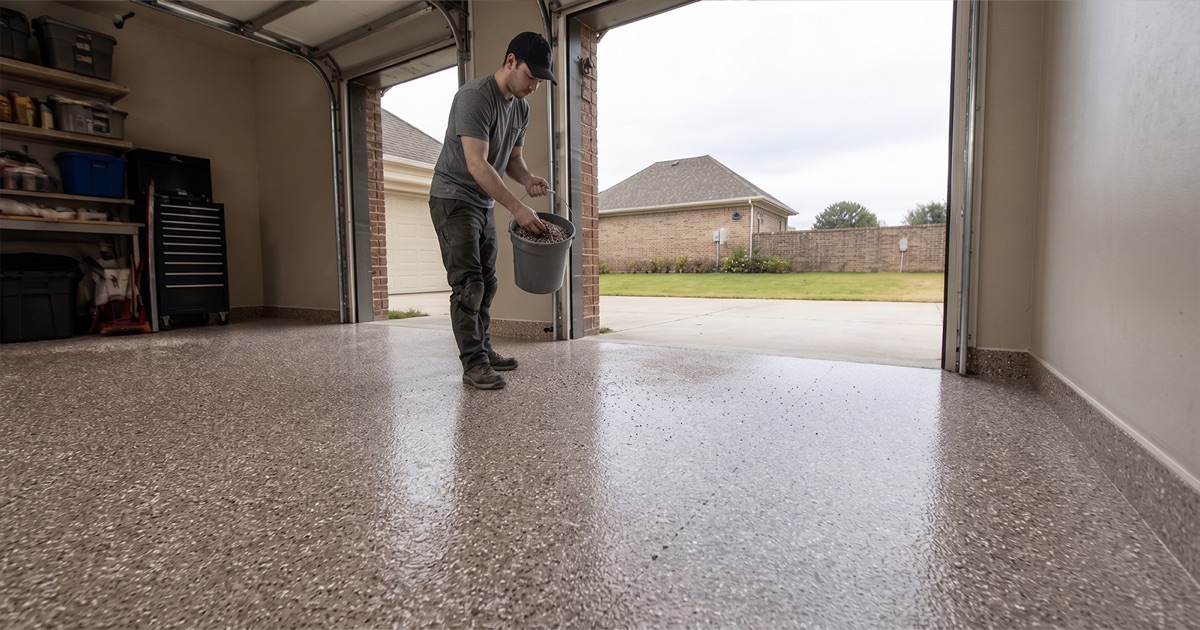
The epoxy body coat is laid at the specified spread rate, flake or quartz is broadcast into it if the system calls for it, the surface is scraped back once cured, and the polyaspartic topcoat is applied within its recoat window. That window has a maximum as well as a minimum, and exceeding it means abrading the whole floor before the topcoat can go on.
Cure and Handover
Foot traffic and vehicle traffic are separate milestones and vehicles are considerably later. We give both dates at handover, because hot tire pickup is what happens when a floor is loaded before the coating has cured through. Both dates go on the handover sheet, since a floor lost to early loading is not a warranty matter and it is avoidable by waiting.
- 20+ Years in the Brazos Valley
- Insured & Registered
- Free Written Proposals