Texas Claypan, Not Blackland Prairie
College Station sits in the Texas Claypan, not the Blackland Prairie that dominates the reputation of Central Texas soils. Area-weighted inside the city, Vertisols account for a fraction of a percent of the ground, which is a fundamentally different problem from a true shrink-swell market and calls for a different specification. Contractors who work both markets tend to carry one mental model between them, and it is the wrong one roughly half the time.
The Sandy Cap and the Clay Beneath It
The typical profile here is an inert fine sandy loam cap with a plasticity index near 4, sitting abruptly on a smectitic clay horizon running a plasticity index of roughly 27 to 41. The cap is 2 to 18 inches thick, and that depth is the single number that changes what your slab is doing. Where the cap is deep, the slab is largely bearing on inert material; where it is thin, the reactive horizon is close enough to matter.
Water That Perches on the Claypan
The clay horizon is very slow to drain, so through winter and spring water sits on top of it rather than moving down through it. That perched water is a reservoir directly beneath the slab, and it drives vapor upward into any coating that is not specified for it. It is also seasonal, which is why a floor can go down clean in September and blister the following March.
Moisture First, Movement Second
On most College Station slabs the first question is how much water vapor is coming up through the concrete, and the second is whether the ground is moving. In a true Blackland Prairie market that order reverses, which is exactly why a specification imported from elsewhere in Texas fails here.
Testing Moisture Properly
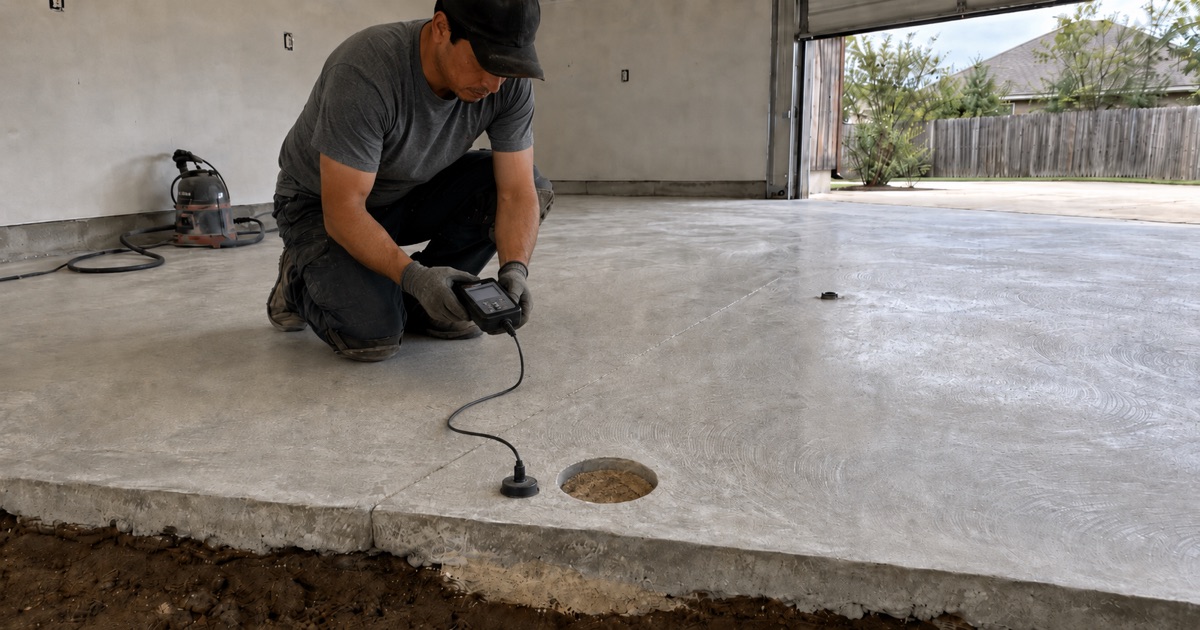
An ASTM D4263 plastic sheet taped to the slab overnight tells you almost nothing. Calcium chloride testing under ASTM F1869 and in-situ relative humidity probes under ASTM F2170 give numbers you can hold a product’s ASTM F710 thresholds against, and those numbers decide whether a moisture-mitigation primer is required. The probes read the slab’s internal humidity at depth rather than its surface, which is the measurement that actually predicts what a coating will face over its life.
Blisters, Bubbles and Sheet Peeling
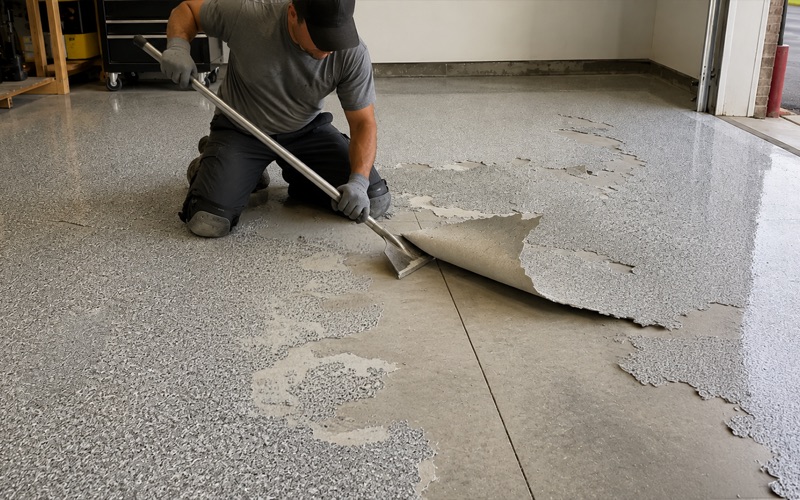
Osmotic blistering, pinholes and a coating that lifts in sheets are usually one story: vapor pressure from below exceeded the coating’s tolerance. We take a moisture reading under a failed floor before quoting the repair, because recoating over the same conditions buys a repeat.
The Vapor Retarder Under a Newer Slab
The city’s own minimum foundation standard calls for a 6 mil polyethylene vapor retarder beneath the slab, and it also caps fill material at a plasticity index between 5 and 18. A slab poured to that standard starts from a very different place than an older one with nothing under it. Worth knowing too that the local claypan subsoil itself runs well above that fill limit, so the material under a slab is not necessarily the material the standard contemplates.
Bryan Slabs and College Station Slabs
The two cities do not share a housing age. Owner-occupied stock built before 1980 runs about 13 percent in College Station against about 36 percent in Bryan, with median build years of 1999 and 1991, so a Bryan garage is far more likely to be a pre-vapor-retarder slab.
Perimeter and Interior on Different Ground
The minimum foundation standard puts the exterior beam at 30 inches deep, which is below the sandy cap almost everywhere in the city. That leaves the perimeter bearing in reactive clay while the interior bears on inert sand, which produces differential rather than uniform movement. Uniform movement lifts a slab evenly and is comparatively benign; differential movement is what cracks one, and it is the pattern this geology tends to produce.
What a Graded Lot Does to All of This
Where a lot was cut and scraped before the slab was poured, the sandy cap may be largely gone and the clay may start within a couple of inches of the underside. The eroded phases of local series are exactly that, and it is why two houses on one street can need different answers.