
College Station Epoxy Flooring has been resurfacing concrete in College Station, Texas for more than 20 years, working throughout Bryan, Lake Bryan, Navasota, Caldwell and Hearne. Resurfacing spans a wide range of work, from a thin decorative overlay on a sound slab through to structural repair on concrete that has spalled down to the aggregate. What these jobs share is that every one of them is bonded to something that already failed once.
An overlay is only as good as its grip on the slab beneath it, and that grip is only as good as our understanding of why the original surface came apart. This is the step that gets skipped, because diagnosing a failure is slower than covering it and the covered version looks identical on the day it is finished.
So we start with cause rather than cosmetics. A surface that spalled from freeze damage, one that delaminated under vapor pressure and one that simply wore through under traffic can look similar from standing height, and each of them needs completely different work underneath whatever goes on top.
Establishing Why the Surface Failed
Spalling, Scaling and Delamination
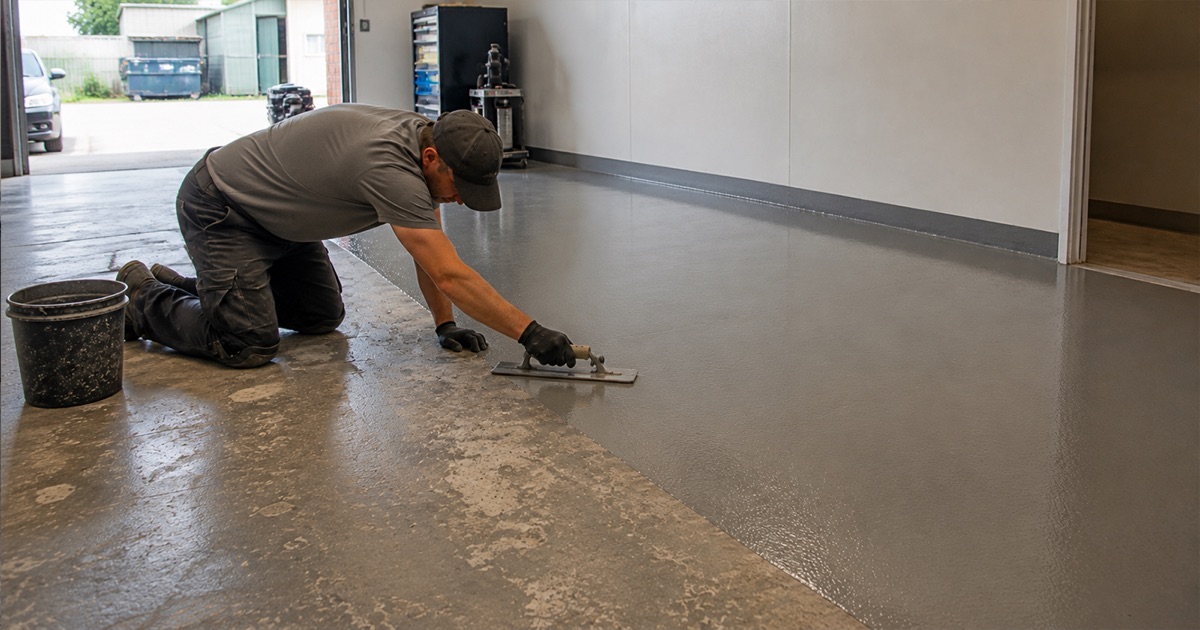
Spalling lifts chunks out of the surface, scaling strips the paste and leaves aggregate standing proud, and delamination separates a thin surface layer that sounds hollow when tapped. Each points at a different origin, from a poor initial float through to vapor pressure from below the slab. Sounding the floor to map the hollow areas is a fast, cheap test that defines the true extent of the work far better than looking at it does, and it routinely finds two or three times the area a visual inspection suggested.
Moisture Driving From Below
An overlay bonded to a slab pushing vapor upward will fail at the bond line no matter how well it was applied. We test with calcium chloride under ASTM F1869 and with relative humidity probes under ASTM F2170 before specifying an overlay, because those numbers decide whether a moisture-mitigation primer belongs underneath it. On this ground, where water perches on the clay horizon through winter and spring, a high reading is a routine finding rather than an unusual one, and budgeting for it up front is cheaper than discovering it later.
Structural Cracking Versus Surface Wear
A crack running the full depth of the slab is a structural condition, and resurfacing over it conceals it briefly rather than resolving it. Surface wear, by contrast, is precisely what resurfacing exists for. Telling the two apart on site is the difference between an overlay that lasts and one that telegraphs a line within its first season. Where a slab has broken into sections that move independently, we say so and price the honest repair rather than the attractive one.
Resurfacing Systems We Use
Cementitious Microtoppings and Overlays
Polymer-modified cementitious overlays go down from a skim coat up to a quarter inch or more, restoring a uniform surface on a slab that is structurally sound but visually finished. They accept integral color and can be troweled, sprayed or stamped for texture. They are the usual answer for a worn interior slab or a patio that has lost its finish without losing its integrity, and they are considerably less disruptive than replacement.
Self-Leveling Underlayments
Where a slab has genuinely lost its flatness, a self-leveling material finds its own plane and delivers a flat surface for whatever goes on top. This is frequently the correct first step before a coating or a floor covering rather than a finish in its own right. Depth, priming and edge detailing all need specifying properly, since self-levelers are unforgiving about being poured over an unprimed or contaminated slab and will delaminate cleanly if they are.
Epoxy Mortars and Patching Compounds
For localized damage, spalled edges and holes that a topping cannot bridge, an epoxy mortar rebuilds the profile in a material considerably stronger than the concrete around it. This is repair rather than resurfacing, and the two are frequently combined across one floor. We identify which areas need which so the quote reflects the actual work rather than an average rate applied to everything, which is how resurfacing quotes usually go wrong.
Exterior and Interior Resurfacing
Driveways, Walkways and Patios
Exterior slabs take ultraviolet light, rain, thermal cycling and, in this region, occasional multi-day hard freezes, so material selection differs from an interior floor. Drainage and the slab’s fall want checking before anything is laid, since an overlay faithfully reproduces a slope that ponds and will hold water in exactly the same place. Freeze damage in particular is a recurring annual mechanism rather than a one-time event, which changes what is worth spending.
Interior Slabs and Commercial Floors
Inside, the questions become moisture, traffic and what the floor has to tolerate chemically. A resurfaced commercial floor frequently receives a resinous system on top, so the overlay is selected for compatibility with what is going over it rather than for its own appearance. Getting that sequence wrong produces a perfectly good overlay under an incompatible topcoat, which is an expensive way to redo both layers at once.
Decorative Finishes
Overlays accept integral color, dyes, saw-cut patterns and stamped texture, which makes resurfacing a genuine appearance upgrade rather than a repair of last resort. The constraint is always the substrate beneath it. A decorative finish laid over a slab nobody diagnosed is a costly way to postpone the same conversation by about a year, and the second attempt starts by removing the first one.
What the Work Involves
Preparation and Bond
Every resurfacing job starts with mechanical preparation to a measured profile, because an overlay bonds to opened concrete rather than to a cleaned surface. Contaminants, old sealers and curing compounds all have to come off entirely. This stage is not negotiable and it is the single largest predictor of whether the finished surface is still attached in five years.
Edges, Terminations and Thresholds
An overlay raises the floor, so door swings, thresholds and transitions all need working out before the pour rather than after it. Terminations at a step, a drain or an existing slab edge are detailed deliberately so the new surface ends in a clean line rather than a feathered edge that chips under the first traffic it sees.
Curing and Return to Service
Cementitious overlays and resinous repairs cure on different schedules, and both are affected by temperature and humidity on the day. Foot traffic returns well ahead of vehicles. We give both dates at handover, because an overlay loaded early loses its edges first and that damage is not repairable without redoing the perimeter.
Working Around an Occupied Building
Most commercial resurfacing happens in a building that cannot close, so the work is sequenced in bays with hard edges planned where the day stops. A cold joint in an overlay is visible forever if it lands in the middle of an open floor, so we place those breaks at columns, thresholds or pattern lines. Dust containment and odor management get agreed before the first machine runs rather than negotiated once staff start complaining.
What We Will Not Resurface
A slab that is actively moving, one sitting in standing groundwater, or one whose failure cause we cannot identify does not get an overlay from us. Covering any of those produces a surface that fails on a schedule nobody can predict, and the second repair always costs more than the first because it starts with removal. Saying no to that work occasionally costs us a job and has never cost us a client.
- 20+ Years in the Brazos Valley
- Insured & Registered
- Free Written Proposals