
College Station Epoxy Flooring coats driveways, aprons, walkways and patios across College Station, Texas and the surrounding cities of Bryan, Lake Bryan, Navasota, Caldwell and Hearne, drawing on more than 20 years of resinous flooring work. An exterior slab is a genuinely different specification from an interior one, and treating it as a garage floor that happens to be outside is how coatings fail early.
Outside, a coating faces direct ultraviolet light, rain, standing water, thermal cycling through a wide daily range and, in this region, occasional multi-day hard freezes. It also has no roof over it, so nothing shields the surface from the conditions that age it fastest.
We quote exterior work separately from interior work for that reason, even when both are on the same property and being done in the same week. The materials differ, the preparation differs, and the honest expectations differ.
What Makes Exterior Different
Ultraviolet Exposure
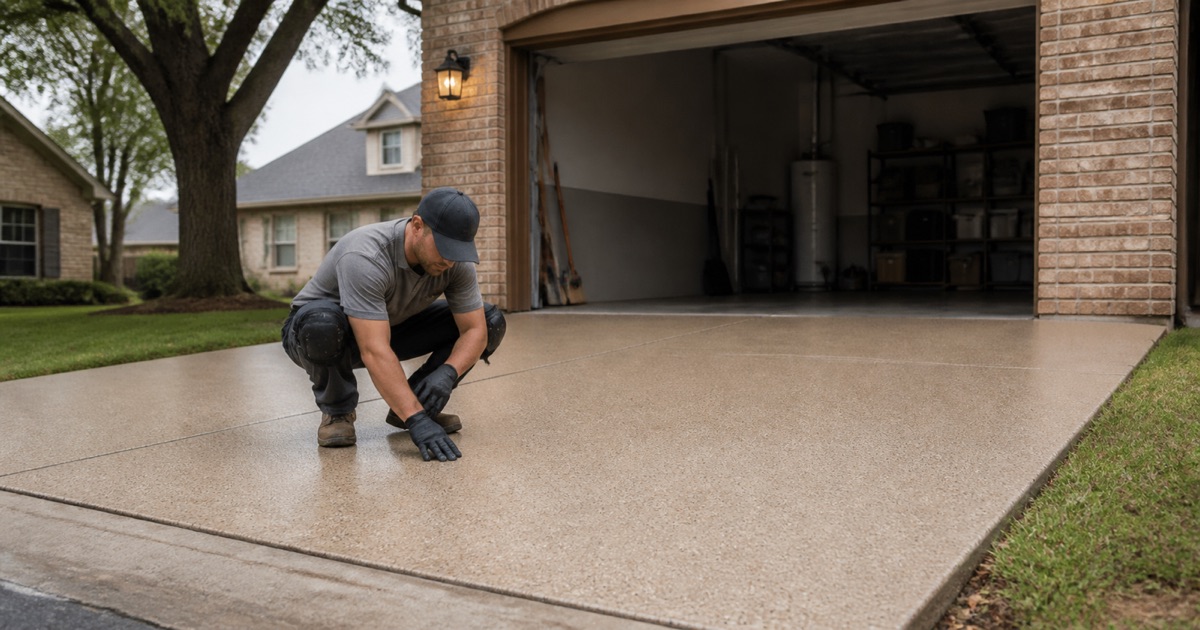
Standard epoxy ambers and chalks under sunlight, which is barely noticeable inside a garage and obvious across an open driveway within a season or two. Exterior work needs an ultraviolet-stable system, which in practice means an aliphatic polyaspartic or polyurea topcoat carrying the exposure rather than an epoxy surface doing it. The difference is visible from the street within the first year, which is why it is not a place to economize.
Thermal Cycling and Freeze
An exterior slab expands and contracts through a much wider daily and seasonal range than an interior one, and the coating has to move with it rather than resist it. Hard freezes are uncommon here but not rare, and they arrive as multi-day events rather than single cold nights, which is the pattern that actually damages concrete and anything bonded to it. A coating chosen for a mild winter behaves differently through a week below freezing than through a single cold night.
Water, Drainage and Fall
An exterior slab is designed to shed water and a coating must not interfere with that. Where a driveway already ponds, a coating reproduces the low spot exactly and then holds water on top of itself. Checking fall and drainage before quoting is part of the assessment rather than an afterthought, because standing water is the single most reliable way to age an exterior coating. Correcting fall means building slope into an overlay, which is a different job and a different price.
Systems That Work Outdoors
Polyaspartic and Polyurea Topcoats
These hold color under sunlight, cure across a wide temperature range and resist the abrasion that grit and tires deliver. Outdoors they are not an upgrade, they are the baseline, and a system without an ultraviolet-stable top is not an exterior specification regardless of what it costs. A quote for an exterior slab that names an epoxy topcoat is quoting the wrong system.
Broadcast Texture for Grip
An exterior slab gets wet, so slip resistance is a safety requirement rather than a preference. A quartz or flake broadcast, or a slip-resistant additive in the topcoat, gives grip that survives traffic. A smooth high-gloss driveway looks impressive dry and is genuinely hazardous after rain. We would rather install a floor that looks slightly less dramatic and is safe to walk on wet.
Overlays and Resurfacing First
Where a driveway has spalled, scaled or lost its surface, a coating alone will not fix it and will follow every defect underneath. A cementitious overlay or targeted repair comes first, and only then does a coating make sense. We say when a slab needs that step rather than coating over damage and calling it done. Coating a spalled driveway without repairing it first is the most common exterior mistake we are asked to fix.
Preparation Outdoors
Cleaning Is Not Preparation
An exterior slab carries years of oil, tire residue, organic growth and frequently a sealer applied when it was poured. Pressure washing removes the loose material and none of the rest. The slab is mechanically ground or shot blasted to a measured profile exactly as an interior floor would be. Pressure washing also drives water into the slab, which then has to dry before anything can be applied.
Cracks, Joints and Slab Movement
Exterior slabs are usually poured in sections with control joints, and those joints keep working after a coating goes over them. They are honored rather than bridged, filled with a semi-rigid material that supports the edges while permitting movement. Coating across a live joint guarantees a crack in the same place. Existing joints are mapped before quoting so the layout of the finished surface is deliberate.
Edges and Terminations
A driveway coating has to stop somewhere, usually at a garage threshold, a street apron or a lawn edge, and those terminations decide how the job looks in three years. A feathered edge chips and then lifts. We detail each termination deliberately so the coating ends in a defined line. Where a driveway meets a street apron the transition is agreed in advance, since that edge takes the most abuse.
Patios, Walkways and Pool Surrounds
Patios and Covered Slabs
A covered patio sits between interior and exterior conditions, taking reflected daylight and humidity without direct rain, and it can frequently carry a lighter specification than an open driveway. Texture matters more here than on a driveway because these are barefoot surfaces, so we usually set the finish softer underfoot while keeping the grip.
Walkways and Entry Slabs
Walkways take concentrated foot traffic on a narrow path and show wear in a line down the middle, so the topcoat specification matters more than the appearance choices. Entry slabs additionally carry grit tracked in from outside, which abrades a coating faster than anything else at that scale.
Coordinating With a Pool Deck
Where a driveway or walkway runs into a pool surround, the two want treating as one specification even if they are installed separately. A pool deck has its own chemical exposure and its own slip requirements, and a mismatch at the junction is visible permanently.
- 20+ Years in the Brazos Valley
- Insured & Registered
- Free Written Proposals