
College Station Epoxy Flooring has been polishing concrete across College Station, Texas and the surrounding cities of Bryan, Lake Bryan, Navasota, Caldwell and Hearne for more than 20 years. Polished concrete is the one system on this site where the floor you finish with is the slab you already own, which makes it the least forgiving thing we do.
There is no coating to hide behind. A grind-and-coat job can bury a patchy pour under pigment; a polish cannot, because the finish is the concrete itself brought progressively to a closed, light-reflective surface. Everything the slab has ever had done to it will still be visible at the end.
That is why we assess before quoting rather than pricing polished concrete by the square foot off a plan. Some slabs in this market polish beautifully. Some should be coated instead, and we would rather say so at the estimate than halfway through a grit sequence.
Whether Your Slab Will Take a Polish
Surface Hardness and What It Dictates
Concrete hardness decides the entire tooling plan, and the rule runs opposite to intuition: a hard slab takes a soft diamond bond and a soft slab takes a hard one. Get that pairing wrong and a hard slab polishes the tooling instead of the floor, while a soft slab is torn open by segments that will not wear. We test hardness before selecting the first set rather than discovering it on the first pass, because a wrong first choice costs a day and a set of diamonds. Hardness also varies across a single pour more often than people expect, so a large floor is tested in several places rather than one.
Aggregate Exposure and How Much You Want
How far down we cut determines the look, and the three broad outcomes are genuinely different floors. A cream finish stays in the surface paste and shows almost no stone; a salt-and-pepper exposure opens fine aggregate evenly; a full exposure cuts into the larger stone and reads almost like terrazzo. Each requires committing to a depth before the first cut, and the deeper the exposure the less forgiving the slab’s flatness becomes. A slab that was never floated flat will show that fact immediately at full aggregate exposure, which is why exposure and flatness are decided together rather than separately.
Patches, Penetrations and Slab History
Old repairs, saw cuts, plumbing penetrations and anywhere a floor covering was glued down will all read through a polish, because polishing reveals rather than conceals. We walk the slab and identify these in advance so nobody is surprised at 400 grit. Where the history is heavy enough, a dyed polish or a coating is the more honest recommendation, and we will make it rather than take the job and hope. Sounding the slab for hollow areas at the same time costs nothing and frequently changes the recommendation before any money is committed.
The Polishing Sequence
Cutting, Honing and Polishing
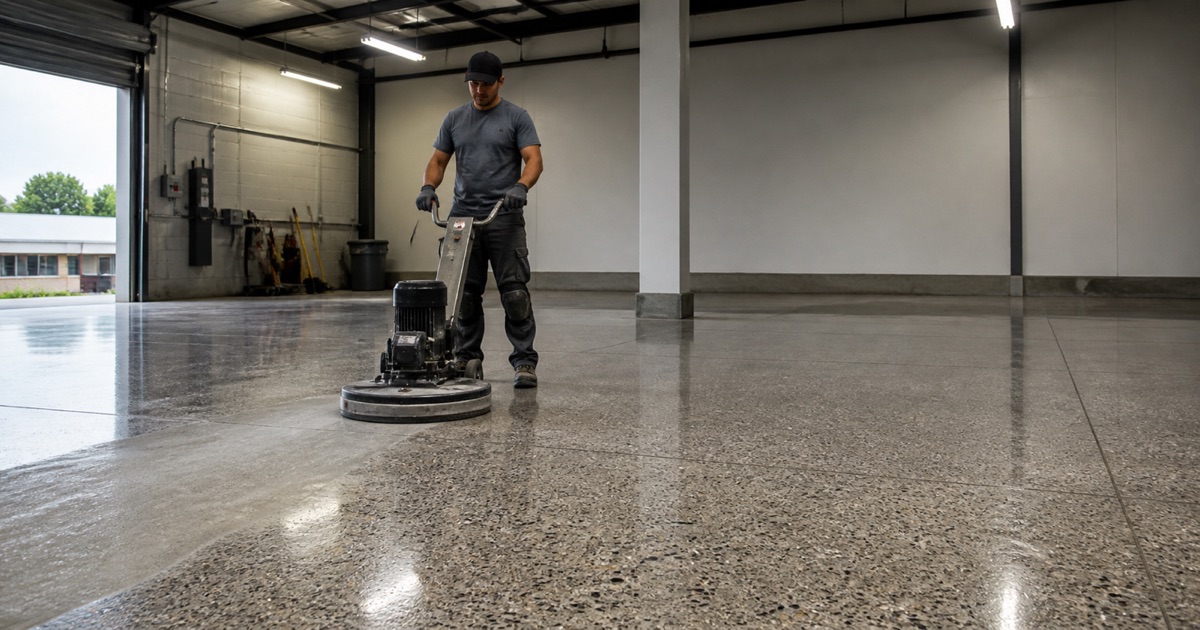
The work runs through a metal-bond cutting stage that establishes flatness and exposure, a transitional honing stage, and a resin-bond polishing stage that closes the surface. Each step has to remove the scratch pattern the previous one left, and skipping a grit shows as a haze that no amount of later polishing will lift. The sequence is the product, and shortening it is the most common way a polished floor comes out dull. It is also why a quoted price that undercuts everyone else usually means fewer stages rather than a better rate.
Densifying the Surface
A lithium silicate densifier is applied mid-sequence and reacts with free lime in the concrete to harden the surface matrix. This is what allows the higher grits to close the floor to a reflective finish rather than simply abrading it. Timing matters, since densifying too early wastes product deep in the slab and too late leaves the surface unable to take the final polish at all. We apply it at the stage the product’s own data sheet specifies rather than at a fixed point in our own routine.
Sealing, Guarding and Maintenance
A penetrating guard protects against staining without adding a sacrificial film that wears through in traffic lanes, which is the point of polished concrete over a coating in the first place. Maintenance is a dust mop and a neutral cleaner rather than a strip-and-recoat cycle. We hand the regime over in writing, because the wrong cleaner will dull a polished floor considerably faster than traffic will. Most premature dulling we are called out to look at is a cleaning-chemistry problem rather than a wear problem.
Where Polished Concrete Suits This Market
Retail, Office and Institutional Floors
A polished slab carries traffic without a coating to wear through, which suits retail floors, corridors and lobbies that cannot close for a recoat. The finish is also permanent in a way a film is not, since there is nothing laid on top of the concrete that can fail. For a building expecting decades of use, that is the strongest argument in its favor and it compounds over time. There is also no downtime cost to budget for every few years, which is frequently the larger number over a building’s life.
Warehouse and Distribution Slabs
A polished warehouse floor reduces dusting from bare concrete, improves light levels without adding fixtures, and stands up to wheel traffic that would abrade a coating. Joint treatment matters more than the polish itself here, since a semi-rigid filler supports joint edges under load and is what prevents the spalling that turns a joint into a recurring maintenance line item. Getting the filler specification right on a warehouse floor matters more to its service life than the gloss level does.
When We Recommend Something Else
A slab with heavy patching, an unknown adhesive history, significant moisture, or a surface troweled to a very hard closed finish may not deliver a polish worth paying for. In those cases a grind-and-coat system gives a better floor for the same money. We would rather lose the polishing job than hand over a floor that displays every repair the building has ever had. Saying so at the estimate costs us a job occasionally and has never cost us a client.
Color, Layout and the Details That Show
Dyes and Integral Color
A polished slab takes penetrating dye readily, and dye behaves very differently from a surface stain because it travels into the densified matrix rather than sitting on it. That makes it durable under traffic but also largely permanent, so the color decision is made once. On a slab with an uneven pour history, a dye is frequently what turns a patchy floor into a deliberate one.
Saw-Cut Patterns and Banding
Cutting a grid, a border or a banded pattern into a polished floor is a low-cost way to give a large slab scale and to disguise existing control joints by making them part of a deliberate layout. The cuts are made before the final polishing stages so their edges close with the rest of the floor rather than staying raw and collecting soil.
Edges, Columns and Transitions
The perimeter is where a polished floor is judged, because a walk-behind machine cannot reach the last few inches and edge work is done separately. Columns, door thresholds and transitions into carpet or tile all need detailing that matches the field of the floor. Skipping that leaves a dull margin around a bright floor, which is the most common visible shortcut in this trade.
- 20+ Years in the Brazos Valley
- Insured & Registered
- Free Written Proposals